We do not start with solutions.
We start with
Sensemaking.
Understanding what is actually happening.
Most interventions fail because they address the visible symptom. Not the underlying behavioural driver.
Before we recommend anything, we map reality. Using behavioural science, consumer neuroscience, ethnography, and data, we answer important questions.
Sensemaking produces a precise diagnosis.
A friction map.
A motivation profile.
A context audit.
It tells us exactly where to intervene and why.
The Friction · Motivation · Context model
Our proprietary behavioural shifts solutions model, built over 15 years of behavioural research, client work and real-world implementations
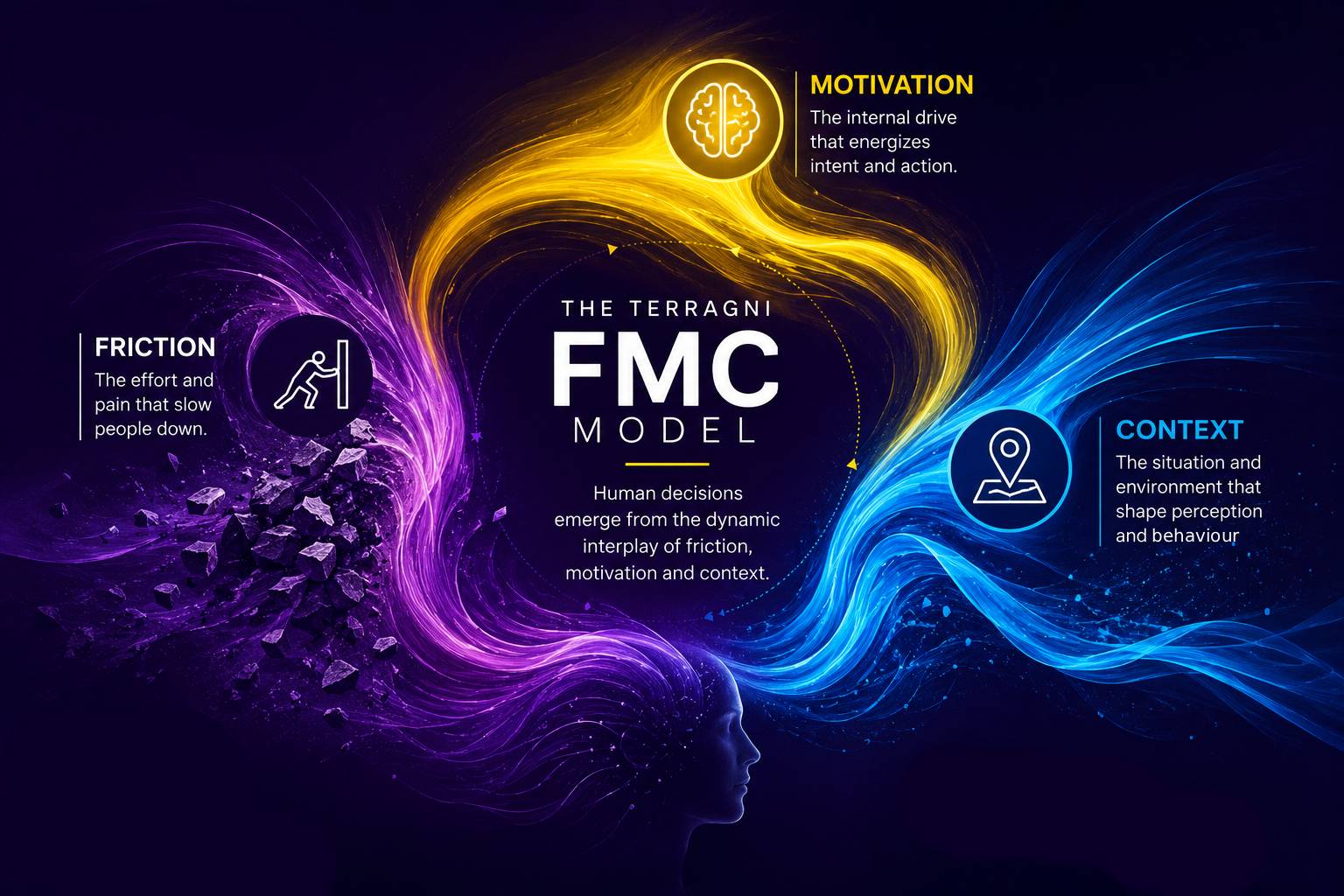
FRICTION
Anything that makes the desired behaviour harder than it needs to be.
Physical. Cognitive. Perceived. Emotional.
Friction is often invisible to the people who designed the system.
It is never invisible to the people living inside it.
MOTIVATION
The underlying drive. Or its absence.
People do not fail to act because they lack information. They fail to act because the action does not connect to something that matters to them.
Or because the cost of acting feels greater than the benefit.
Motivation can be strengthened. Redirected. Unlocked.
It can also be quietly destroyed by the wrong environment.
CONTEXT
The environment that shapes every decision and every behaviour.
The defaults. The cues. The social signals.
The choice architecture around every action.
Context is the most underestimated lever in business. Change the context and behaviour changes. Often without changing the person at all.
Most organisations address one of these at a time.
A process redesign tackles friction.
A rewards programme targets motivation.
A culture initiative tries to shift context.
None of them work well in isolation.
Because behaviour lives at the intersection of all three.
We work across all three. Simultaneously.
Intervention design and implementation
With a clear diagnosis, we design targeted interventions. Changes to journeys, environments, communications, systems, and structures that shift behaviour in the direction the organisation needs.
Our interventions are specific, testable, and built to sustain. We do not design for the launch. We design for what happens six months after it. When the energy fades. When the real test of behaviour change begins.
In practice, this looks different for every organisation. But the logic is always the same.
Find the friction.
Understand the motivation.
Reshape the context.